Join us as we take one last look at the Mercedes-Benz X-Class, the luxury pick-up that was gone almost as soon as it arrived

Meet Mercedes’ first and only pick-up truck: The Mercedes-Benz X-Class.

It arrived in late 2017 and was discontinued just a few short years later, in spring 2020.

In fact, we got our hands on one just a couple of weeks before Mercedes announced it was pulling the plug.

But why did it bow out so soon?

Well, underneath, it was built on the Nissan Navara platform, which also underpinned the Renault Alaskan through the Renault-Nissan-Mitsubishi Alliance. Just with a Mercedes badge chucked on the front.

And a much higher price tag.

Only around 50,000 were sold globally, and it never made it to North America.

It was pitched at both work and family life: Tough enough for the building site, but smart enough (and with enough seats) for the school run.

But was it a true Mercedes? Or just a Navara with a star on the bonnet?

Let’s find out.

What we drove

  • Model: Mercedes-Benz X-Class X 220d 4MATIC Progressive
  • Body Style: Double-cab pick-up
  • Power: Diesel (163 PS)
  • Engine: 2.3-litre four-cylinder (2,298cc)
  • Transmission: Six-speed manual
  • Drive: Selectable four-wheel drive (4MATIC)
  • Acceleration: 0-62 mph in 12.9 seconds+
  • Fuel economy: Up to 35.8mpg (official combined) 
  • Towing: Up to 3,500kg (braked)
  • Payload: Up to 1,140kg 
  • Colour: Kabara Black Metallic 

Specifications correct at the time of our drive

Or watch our video review over on YouTube:

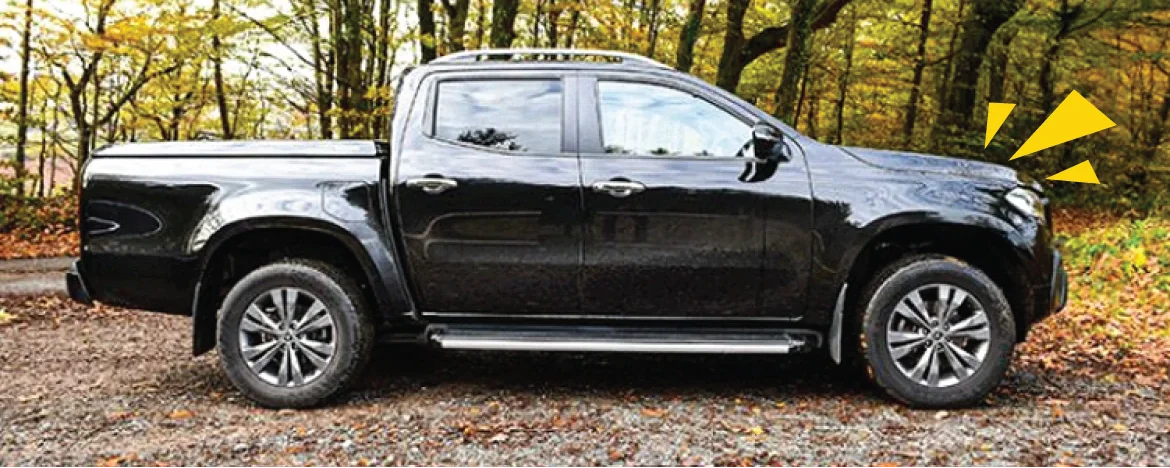
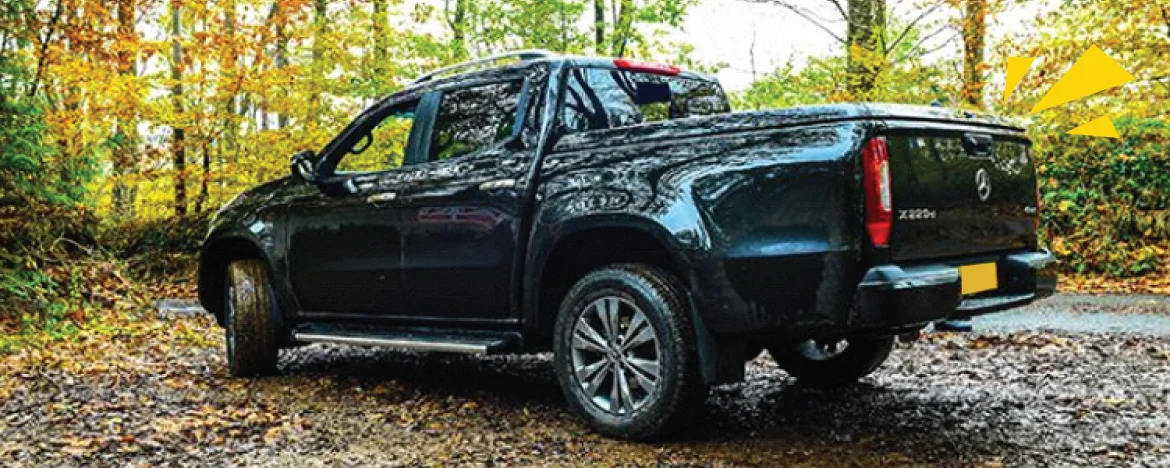
Mercedes-Benz X-Class side profile

Premium looks throughout

Workhorse with a three-pointed star

With a length of 5,340mm and a 3,150mm wheelbase, the X-Class was a beast.

That said, it was only marginally longer than the Navara and Toyota Hilux, and still shorter than the Ford Ranger.

It was huge, and it felt it. But that’s exactly what you’d expect from a workhorse pick-up.

And it had the practicality to match. 

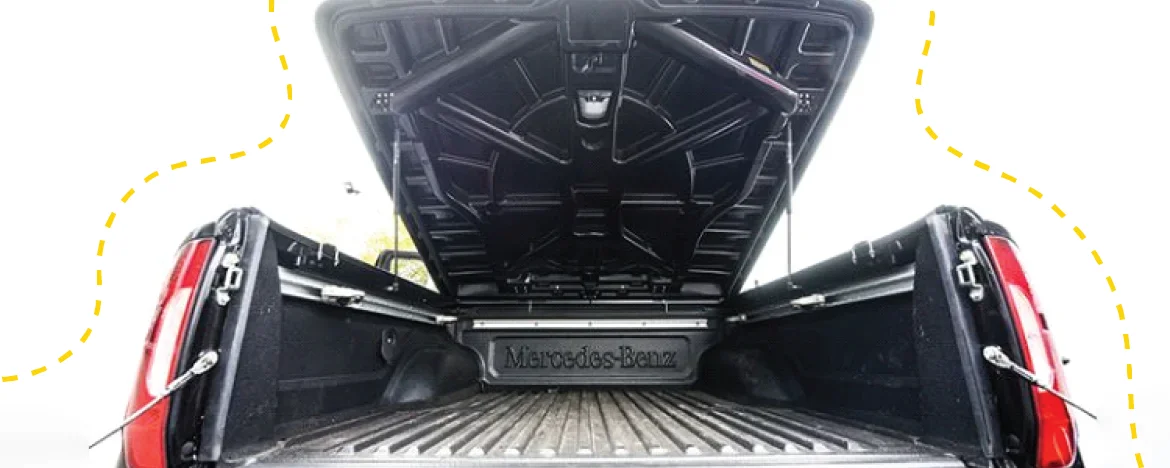
Mercedes-Benz X-Class load bed

Plenty of space

The load bed measured over 1.5m in each direction, so a Euro pallet fitted flat between the wheel arches with no tilting required.

It was LED-lit and plastic-lined too, with four tie-down loops to keep everything in place. Towing? The trailer socket electrics came with trailer stabilisation built in.

Our pickup also had the optional black hardtop, which kept smaller kit dry and secure. Handy, though less useful if you were planning on hauling bulkier loads.

Up front, Mercedes reworked the Navara’s face, adding a twin-louvre grille with a big star front and centre.

Flared arches and a kinked beltline added extra muscle, and arguably, it trumped the Navara on style. Though the family resemblance was still easy to spot.

We drove the Progressive trim, which came with painted bumpers and a matt black underguard. But top-spec Power models got a chrome front that made it look even more Mercedes.

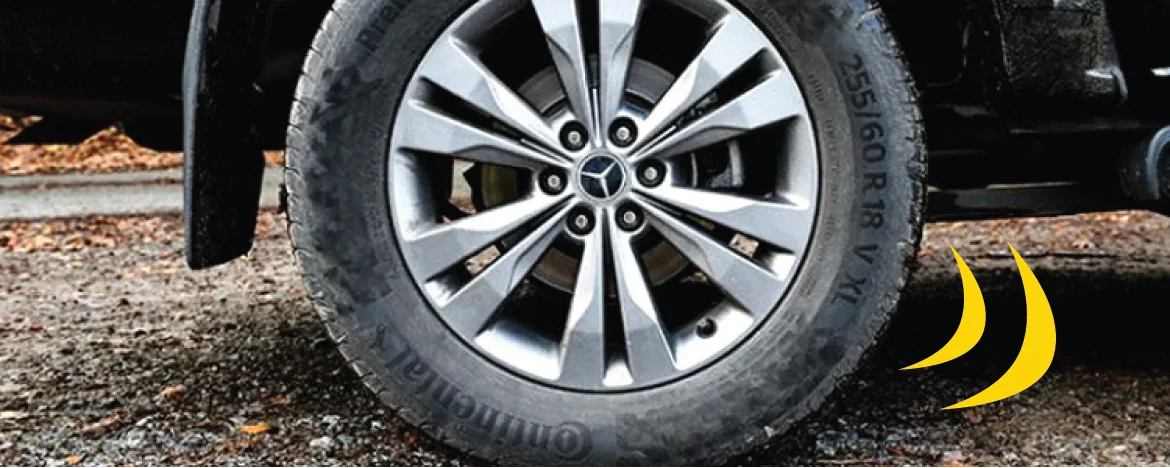
On top of that, ours came with the Style package, adding LED headlights, daytime running lights (DRLs) and brake lights, plus privacy glass, running boards, anodised roof rails and 18-inch alloys.

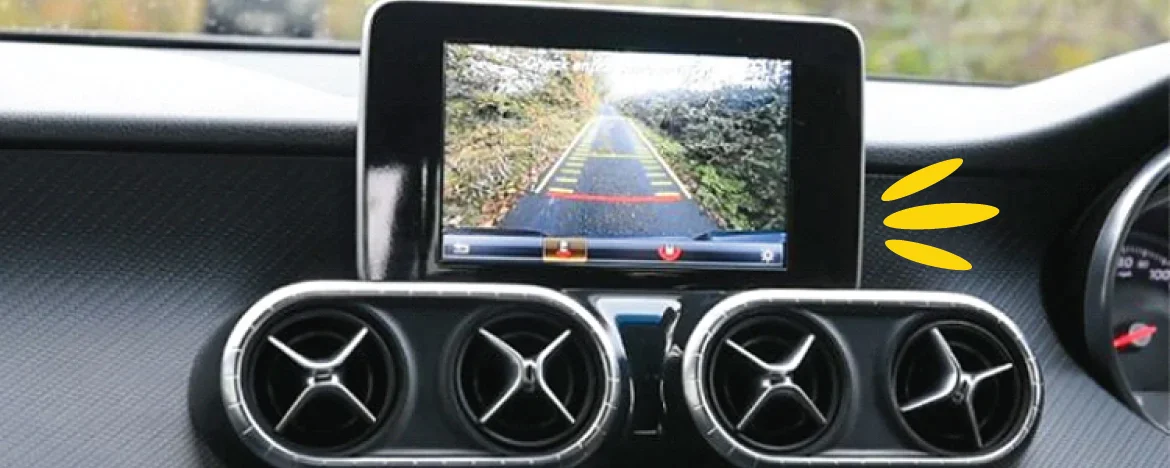
Mercedes-Benz X-Class reverse camera

Premium and practical

Premium badge, practical cabin

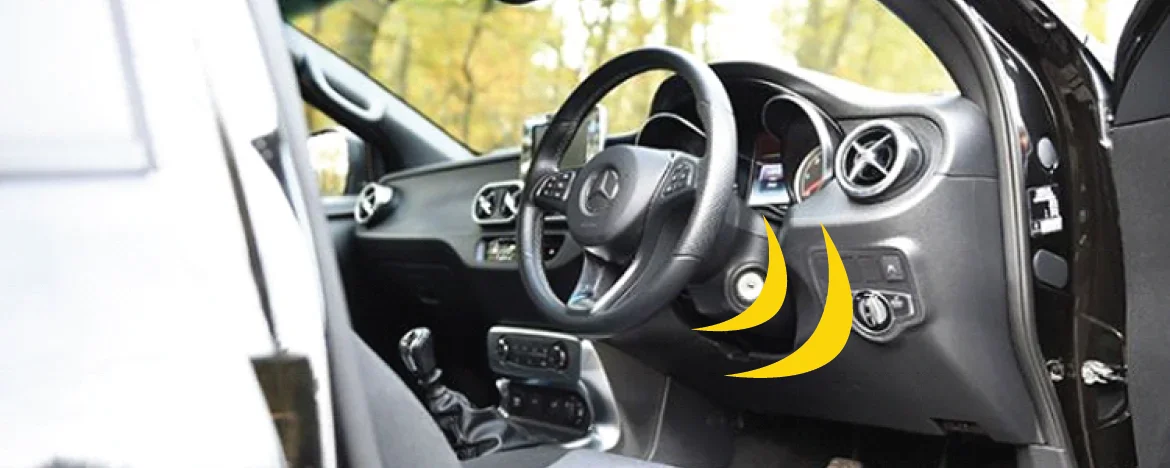
Step inside, and the X-Class was mostly premium-feeling.

Mostly being the key word. Think Mercedes above the knees, Nissan below.

Lower trims came with plenty of hard plastics. Not the most premium touch, but they were durable and easy to wipe clean, which is exactly what you want after a muddy day on site.

We had cloth seats, which were hard-wearing, cool in summer and warm in winter. Spec up to Power trim, though, and you got ARTICO man-made leather with DINAMICA microfibre.

There was plenty of room up front too.

And the tech? A seven-inch HD screen with DAB radio and Mercedes me Connect sat proudly on top of the dash.

A reversing camera came as standard on every model, which was a godsend in something this size. Keyless Go, semi-automatic air con and hill start assist were all handy to have too.

And to top things off, there was an auto-dimming rear-view mirror with a built-in compass.

It wasn’t all smooth sailing, though. The touchpad was fiddly to use on the move, so we found ourselves reaching for the rotary dial instead. The system as a whole was a little laggy too.

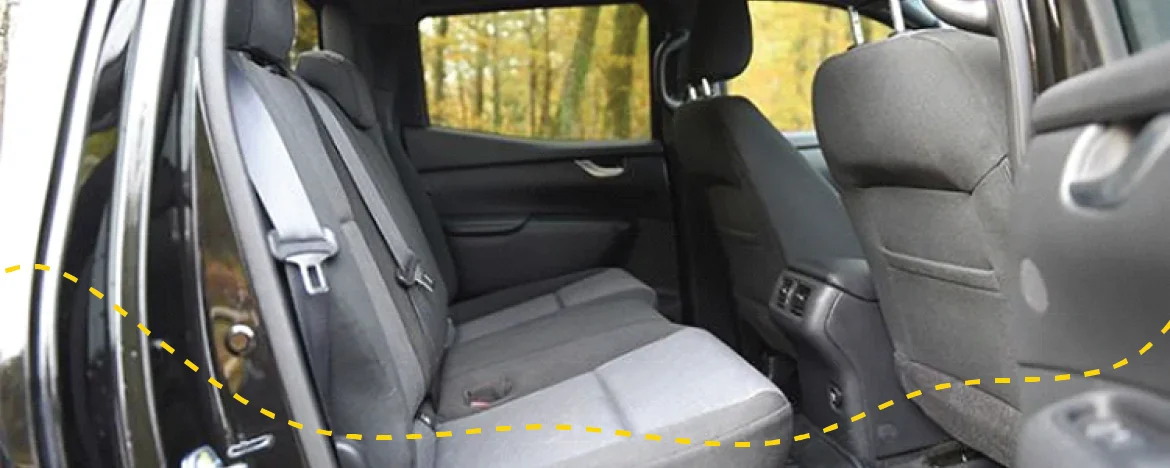
In the back, there was enough room for two adults, though the slightly raised floor meant your knees sat a little higher than you might like. Space was similar to the Navara, and a bit more generous than the Hilux.

It made a great family wagon too, with i-Size and ISOFIX points with Top Tether on the outer rear seats. The rear windows were electric as well, making it simple to pop them down for the kids on a hot summer’s day.

Mercedes-Benz X-Class driver's side

A companion for work and family life

A workhorse first, a cruiser second

Let’s get one thing straight: The X-Class drove like a truck. Because it was one.

Our X 220d’s 163PS didn’t feel especially punchy, and 0-62mph took a leisurely 12.9 seconds. Push the 2.3-litre four-cylinder hard and it got pretty gruff too.

Ours had the six-speed manual, and honestly, we’d have gone for an auto. Smooth, effortless gear changes are what Mercedes does best, after all. That said, the seven-speed auto wasn’t perfect either, with some reviewers finding it a touch hesitant between changes.

Want more grunt? The range-topping X 350d was the one to have.

Its 3.0-litre V6 was the only Mercedes-built engine in the line-up, delivering 258PS, 0-62mph in 7.9 seconds and permanent 4MATIC four-wheel drive. It was smoother, quieter, and shrugged off heavy loads with ease.

The ride was firmer than you’d get in a comparable Mercedes SUV. But where a GLE was the epitome of comfort, the X-Class was a workhorse at heart. It couldn’t just be a GLE with a load bed.

Credit where it’s due, though. Mercedes retuned the suspension and widened the track, making it more composed than the Navara or Hilux. It coped well on standard roads at speed, though the VW Amarok and Ford Ranger were comfier still.

Steering was slow at 3.4 turns lock to lock, and while it was weighty, there wasn’t a lot of feel. There was noticeable body lean through corners too. But it never felt unsettled, and no pick-up is built for B-road heroics.

Out on the motorway, it was a comfortable cruiser, with a high driving position that let you see right over the traffic ahead.

Town was a different story. At 5.34m long, multi-storey car parks were a challenge, and it barely squeezed under 2m height barriers. Thank goodness for that reversing camera.

Get it off the tarmac, though, and the X-Class came into its own.

Selectable four-wheel drive with low-range gearing came as standard on the four-cylinder models, with an optional locking rear differential for extra traction. Ground clearance was up to 221mm, and it could wade through water up to 600mm deep.

And when it came to graft, every X-Class could tow up to 3,500kg and carry over a tonne in the load bed. Just be aware the brakes could feel a little stretched when fully laden.

Mercedes-Benz X-Class wheel

A beast

Big truck, big appetite

Officially, the X 220d and X 250d managed up to 35.8mpg (combined), while the V6 X 350d returned up to 31.3mpg. These figures came from the older NEDC test, though, and real-world numbers told a different story.

You’d have expected around 27–29mpg from the four-cylinder models in mixed driving.

CAR magazine’s V6 long-termer averaged between 24 and 27.6mpg over around 11,500 miles, creeping closer to 30mpg once the engine had loosened up. Steady motorway runs at 60mph could stretch that to around 33mpg.

Why so thirsty? Over 2.2 tonnes of unladen weight, four-wheel drive, heavy loads and towing all took their toll. The V6 got through its fair share of AdBlue too.

CO2 emissions sat at 207g/km for the X 250d and 237g/km for the V6.

That weight had another knock-on effect.

Because its unladen weight exceeded 2,040kg, the X-Class fell under goods vehicle speed limits: 50mph on single carriageways and 60mph on dual carriageways, rather than the usual 60mph and 70mph.

Worth knowing before you set the cruise control.

But being classed as a commercial vehicle wasn’t all bad news. For years, it meant pick-ups were taxed at a flat van benefit rate, a big draw for company car drivers.

That perk has since been scaled back. HMRC changed the rules from April 2025, and double-cab pick-ups are now treated as cars for Benefit in Kind (BiK) purposes.

Some older agreements can stay on the previous rules for a transitional period, so it’s worth checking before you sign anything.

Safety and warranties

The X-Class earned a five-star Euro NCAP rating in 2017, a rare achievement for a pick-up.

  • Adult occupant: 90%
  • Child occupant: 87%
  • Vulnerable road users: 80%
  • Safety assist: 77%

Standard kit included autonomous emergency braking (AEB), lane keeping assist, traffic sign recognition and a seatbelt reminder. It wasn’t flawless, though, as rear-seat whiplash protection was rated poor.

Every X-Class came with a three-year, unlimited-mileage manufacturer warranty, giving buyers peace of mind on and off the job.

Mercedes-Benz X-Class back seats

Pros and cons

What’s good, and what’s not

The good bits:

  • Unmistakably Mercedes styling on a working truck
  • Up to 3,500kg towing across the range
  • Over a tonne of payload in every version
  • Euro pallet fitted flat between the wheel arches
  • Five-star Euro NCAP rating, rare for a pick-up
  • More composed ride than the Navara or Hilux
  • ISOFIX on the outer rear seats for family duty

The not-so-good bits:

  • Nissan Navara underpinnings were hard to ignore
  • Expensive next to the Ford Ranger and VW Amarok
  • Hard plastics and borrowed Navara switchgear
  • Four-cylinder diesels were gruff and slow
  • Slow steering and plenty of body lean
  • Laggy infotainment and a fiddly touchpad
  • Huge size made car parks a challenge
Mercedes-Benz X-Class parked up

What’s the verdict Mercedes-Benz X-Class?

What’s the verdict?

So, was it a true Mercedes, or just a Navara with a star on the bonnet?

Honestly? A bit of both.

The X-Class looked the part, towed and hauled with the best of them, and earned a five-star safety rating most pick-ups could only dream of. Mercedes clearly did more than just swap the badges.

But the Navara bones were never far from the surface, from the hard plastics to the gruff four-cylinder engines.

And with a price tag well above the Ranger and Amarok, it was too expensive for those who treated their pick-up purely as a tool. Yet it wasn’t refined enough to tempt buyers away from premium SUVs either.

For the right person, with a job and a lifestyle that both needed a truck, it was brilliant. There just weren’t enough of them.

Still, it proved there was an appetite for a premium pick-up. This one might be gone, but it’s not forgotten.

Five reasons the X-Class will be missed

  1. A premium badge on a properly capable workhorse
  2. 3,500kg towing and over a tonne of payload
  3. Five-star Euro NCAP safety
  4. The silky V6 X 350d
  5. Genuine work-and-family versatility in one vehicle

Would we recommend leasing a Mercedes-Benz X-Class?

Yes, in spirit. But with production ending in 2020, you won’t find a new one to lease today.

The good news? What made the X-Class special lives on.

Whether you need a hard-working pick-up that doubles as a family car, or a premium SUV with the towing ability to match, there are plenty of brilliant alternatives out there.

Looking for one car that can handle the working week and the school run? Our friendly team will help you find the perfect fit for your lifestyle and your budget.

Need help finding the perfect vehicle for you?

Alice Poole

Alice Poole

Alice applies her extensive test drive experience and her passion for motors to bring you informed and characterful articles and vehicle reviews.