Join us as we take a closer look at the Volvo XC90, the big Swede promising space, style and serious peace of mind

The Volvo XC90 is an old favourite that’s been with us for over a decade. And now it’s had a facelift to keep it competitive in an ever-changing, ever-improving market.

It’s been on sale since 2015, and was the first car built on Volvo’s Scalable Product Architecture (SPA), which now underpins every 60 and 90 Series model.

The all-electric EX90 was meant to replace it as we head into this new electric world. But Volvo decided to keep the XC90 around “for as long as there is demand.”

And you can see why. The XC90 has sold around 100,000 cars a year since 2016. It’s got a proven track record, and Volvo’s reputation for safety gives families the reassurance they need.

Seven seats come as standard too, and that includes the plug-in hybrid version. So whether it’s the school run, the weekly shop, or a car full of kids’ mates, the XC90 is built for busy family life.

Whereas rivals like the Audi Q7 lose their third row when you go plug-in. Or the BMW X7 with seven seats as standard but no hybrid option. The XC90 isn’t just one-upping them, it’s beating them where it counts.

But here’s the thing: Chinese brands are arriving in the UK with all the tech you need, for a much lower price.

So can this ten-year-old luxury SUV keep its grip on the market, or will families start shopping around?

We drove the pre-facelift model, so let’s see how it held up, and what Volvo has improved since.
What we drove

  • Model: Volvo XC90 B5 R-Design AWD (mild hybrid diesel)
  • Body style: SUV
  • Power: 235 bhp
  • Acceleration: 0-60mph in 7.4 seconds
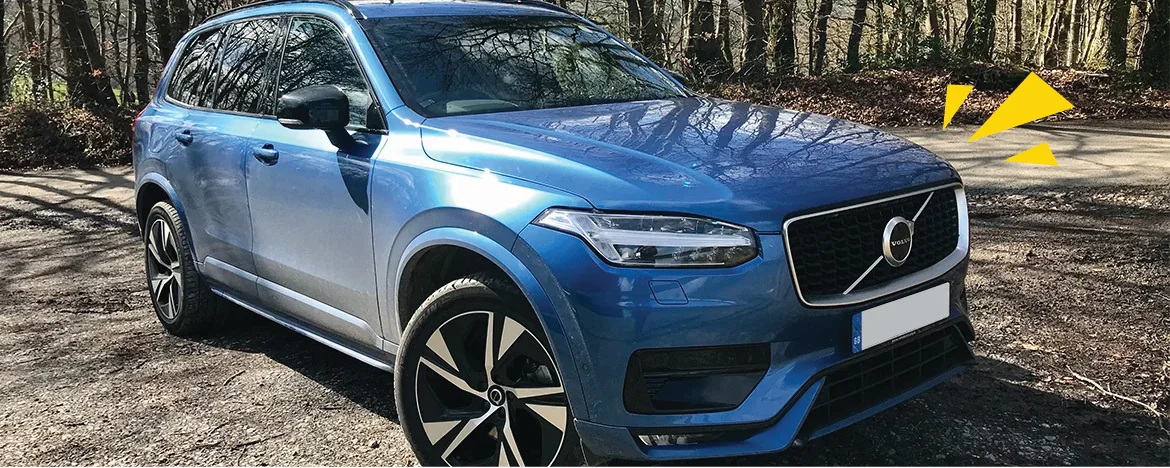
  • Colour: Bursting Blue Metallic
  • Transmission: Eight-speed automatic, AWD

Specifications correct at the time of publication

Volvo XC90 parked up

Scandi style

Scandi cool that hasn’t aged a day

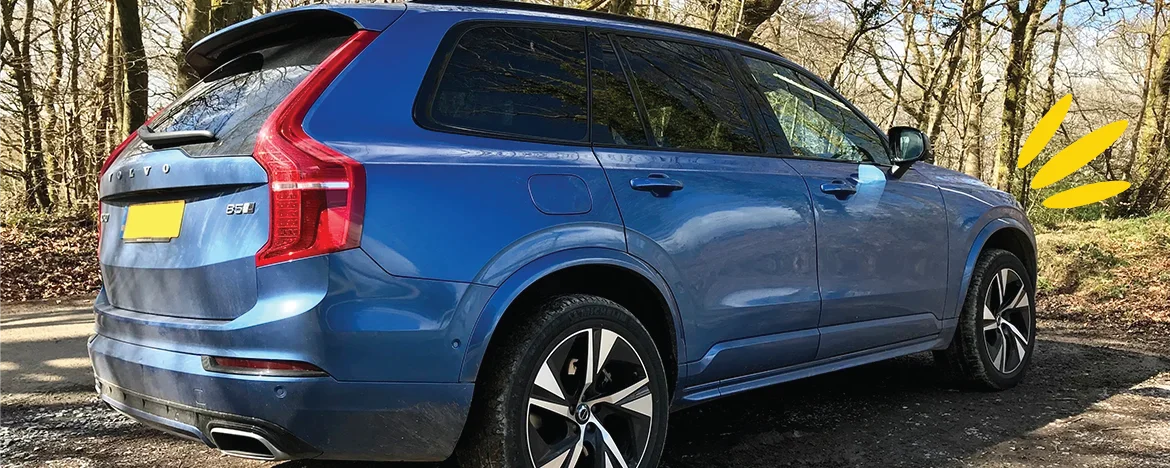
Our XC90 came in R-Design trim, with high-gloss black on the bumper, door mirrors, window surrounds and grille. It made the big Volvo look every bit the premium beast it is.

Twenty-inch five-spoke alloys and dark tinted windows only added to that sporty edge.

Up front, the active bending headlights (with Adaptive Shadow Technology, no less) sat within Volvo’s signature Thor’s Hammer design, flanking a chunky vertical-slat grille.

Fast forward to the facelift, and the changes are subtle but smart.

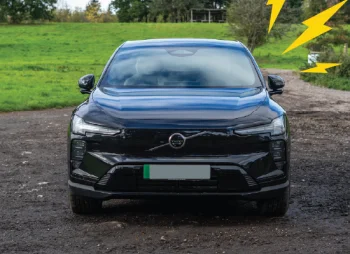
There’s a new air intake framing Volvo’s iron mark, plus a sculpted new bonnet, front wings and bumper. A new grille with a diagonal mesh pattern sits front and centre, replacing those vertical slats.

The Thor’s Hammer headlights are slimmer too, now using matrix-design LEDs with automatic high beams and cornering lights as standard.

Plus, the car now greets you. A welcome and farewell light animation plays as you approach or leave, which is a real premium touch.

At the rear, the taillights are now dark-tinted, and new alloy designs range from 20 to 22 inches.

R-Design is gone, too. Trims now come in Bright (chrome) or Dark finishes: Core is Bright, Plus is Dark, and Ultra gives you the choice.

But the silhouette hasn’t changed. It’s still just under five metres long, yet less bulky at the kerb than an Audi Q7.

It’s classic Volvo restraint: Evolution, not revolution.

Volvo XC90 interior

Minimalism galore

Minimalist, plush and properly practical

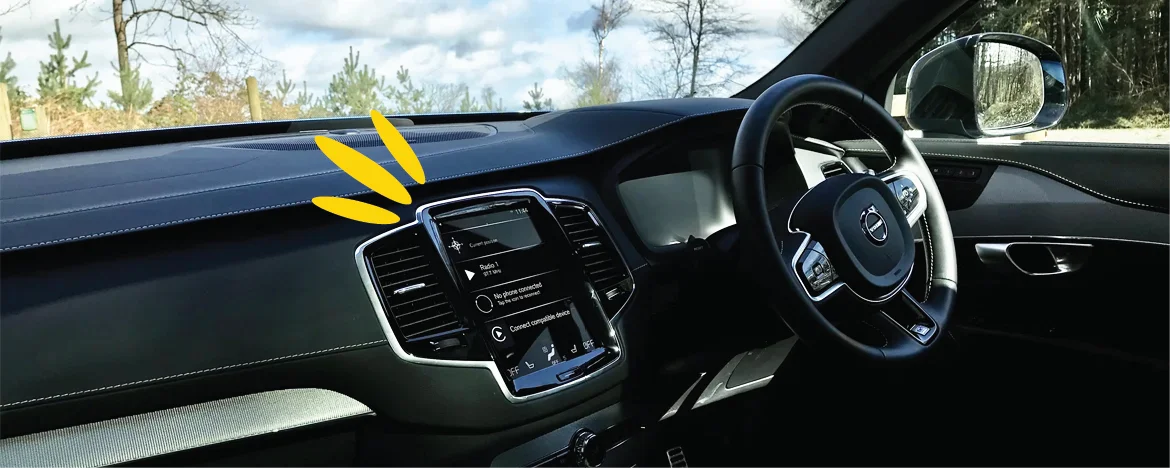
Step inside, and the XC90 was (and still is) a Scandi dream.

Soft perforated leather-effect door trims and a soft-touch dash gave our car a genuinely premium feel, paired with Charcoal Nappa leather and metal mesh inlays.

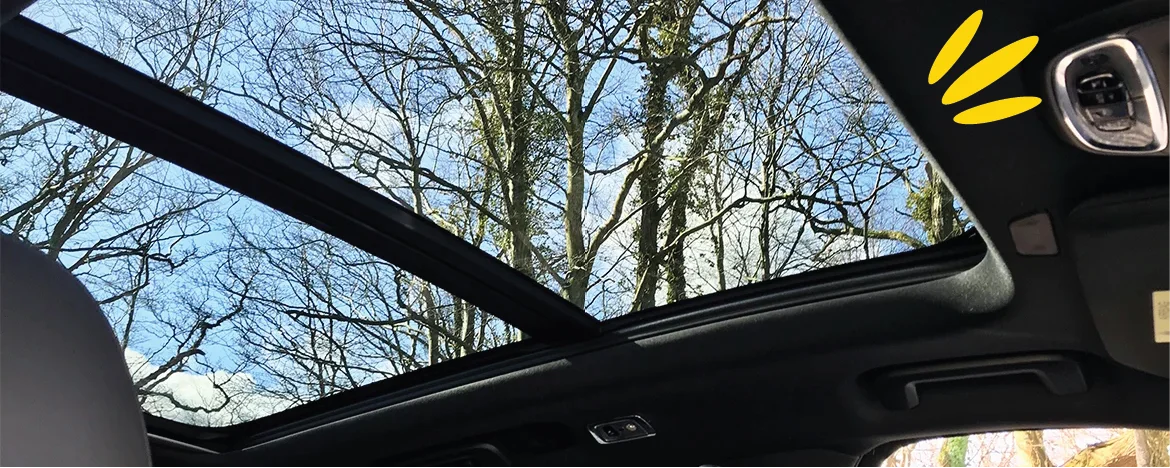
The star of the show, though? The powered panoramic sunroof, part of the optional Xenium Pack.

The memory seats were on the firmer side, and the centre armrest had cupholders but no extra storage.

A nine-inch portrait touchscreen sat in the middle of the dash, angled towards the driver. Most controls, climate included, lived in the screen. Minimalism to the extreme.

Behind the wheel, the 12-inch driver’s display was clear, but nowhere near as customisable as BMW or Mercedes systems.

The Harman Kardon premium sound system filled the cabin nicely, and the Winter Pack added a heated steering wheel, heated windscreen and heated washer nozzles.

Our car also had four-zone climate control, air con for the third row and little mesh sunshades on the rear windows. That means fewer “I’m too hot” complaints from the back.

Seven seats come as standard, and that’s still the case today, even on the plug-in hybrid.

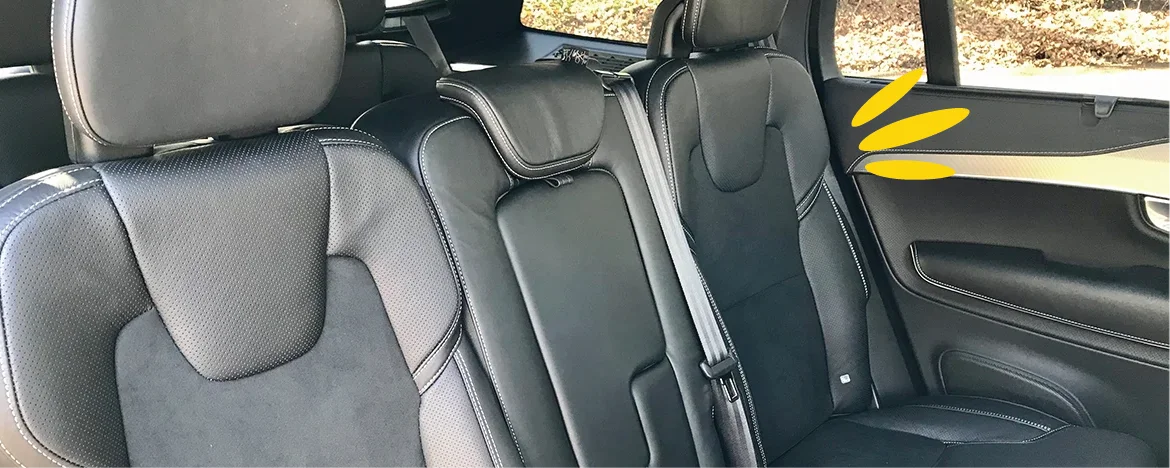
The second row has three individual seats that slide and recline, so you can pass legroom back to whoever’s in row three. There are ISOFIX points on the outer seats, and an optional integrated booster seat in the middle means one less car seat to wrestle with.

The third row folds manually with a lever. Getting in takes a bit of contortionism and space is limited, so it’s best kept for shorter journeys or the kids.

Fast forward to the facelift, and the dashboard has been redesigned with decorative panels made from premium recycled materials, tailored stitching and new vertical air vents.

There are new door panels and mood lighting too, and the panoramic sunroof is now standard on everything except Core.

The centre console has been reworked with extra storage and an extra cupholder, and the wireless charger has moved behind the central tunnel.

The biggest change? The nine-inch screen has been swapped for an 11.2-inch display with Google built-in, so Google Maps, Google Assistant and apps from Google Play are all at your fingertips.

A Snapdragon chip makes it more than twice as fast as before, with graphics up to 10 times faster. Over-the-air updates and four years of unlimited in-car data (Volvo Car Connect Plus) keep it current.

Climate controls still live in the screen, and the driver’s display hasn’t been updated, so that gripe still stands.

Bowers & Wilkins is now the top audio option, and Volvo reckons it’s one of the best-sounding systems you’ll find in a car.

Volvo XC90 boot

Plenty of space

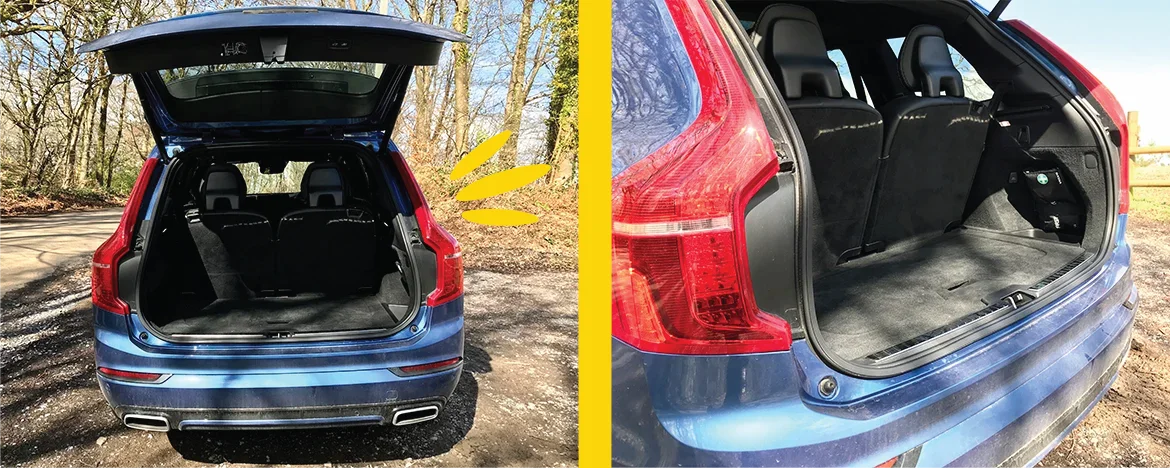
Back in the boot, there’s plenty of room. You get 302 litres with all seven seats up, 680 litres with five, and up to 1,856 litres with just the front two in use. The plug-in hybrid gives up a little space for its battery (262 and 640 litres respectively).

A flat load floor with no lip makes loading easy, and air suspension models can even lower the rear.

That’s still room for the weekly shop with every seat filled. With the third row folded, there’s space for a family holiday’s worth of luggage.

Volvo XC90 parked up

Refined despite it's size and weight

Relaxed, refined and reassuringly Volvo

There’s no denying the XC90 is a big, heavy car. But our B5 diesel carried its weight well and shifted when it needed to.

It was surprisingly easy to manoeuvre for its size too, with good visibility all round.

The second-row headrests did block part of the rear window, though the 360-degree camera meant it was never really a problem. Power-folding headrests were also an option.

The brakes were responsive, and with four drive modes (Eco, Comfort, Dynamic and Off- Road) there was a setting for every drive and driver.

The steering was slightly vague. It was safe and predictable, but a BMW X5 is more fun.

Post-facelift? Diesel is gone.

The UK line-up is now a B5 petrol mild hybrid (250hp) or a T8 plug-in hybrid (455hp), both with an eight-speed automatic gearbox and all-wheel drive.

The B5 petrol is smooth and relaxed in everyday driving, though it does get a tad coarse above 4,500rpm. It does 0-62mph in 7.7 seconds claimed.

The T8 punches much harder, and its One Pedal Drive lets you speed up and slow down with the accelerator alone, which is ideal for stop-start traffic and the school run.

Volvo has also retuned the suspension and dampers for a comfier ride, and added extra acoustic foam to cut road and wind noise. Air suspension is available from Plus trim upwards.

The four drive modes have been replaced by separate soft and firm settings for the suspension and steering, plus an Offroad mode.

Petrol or plug-in: How far can you go?

We drove the B5 diesel mild hybrid, which emitted 156g/km of CO2. But the facelift has dropped diesel, leaving two choices:

  • B5 petrol mild hybrid
  • T8 plug-in hybrid

Volvo claims the mild hybrid system delivers up to 15% fuel savings in real-world driving. Official economy is 30.7–33.6mpg, but expect mid-20s to low 30s in reality.

The plug-in hybrid offers up to 44 miles of electric-only range (WLTP Comb). In real-world driving, that’s more like 30–33 miles, which is still enough for most school runs and commutes.

Officially, that adds up to 176.3–235.1mpg, though that assumes you’re charging regularly. Even with a flat battery, you can expect 32–35mpg.

Its 18.8kWh battery (14.7kWh usable) gives around double the electric range of early XC90 T8s, though it’s still small next to rivals offering 25–38kWh.

Charging is AC only, so there’s no rapid charging, but a full charge takes around three hours.

And Volvo says the real-world range could improve further with future over-the-air updates.

Volvo XC90 back seats

How safe is it?

Safety and warranties

The XC90 scored the full five stars when Euro NCAP tested it in 2015:

  • Adult occupant: 97%
  • Child occupant: 87%
  • Pedestrian: 72%
  • Safety assist: 100%

Volvo was also the first manufacturer to score perfect marks in Euro NCAP’s autonomous emergency braking (AEB) car-to-car rear-end tests.

For parents, the child protection results are reassuring.

The XC90 scored maximum points for protecting both 18-month-old and three-year-old dummies in Euro NCAP’s crash tests. Every child seat it’s designed for could be properly fitted, even in the third row.

That rating has since expired, but Volvo has kept updating the XC90’s safety systems ever since.

Safety is in Volvo’s DNA, after all: This is the brand that invented the three-point seatbelt. The SPA platform makes extensive use of boron steel for strength.

Our car came with Intellisafe Surround (blind spot information with steer assist, cross traffic alert with autobrake and rear collision mitigation), plus pedestrian, cyclist and large animal detection with automatic braking.

The facelift brings Volvo’s latest advanced driver assistance systems (ADAS) sensor platform, using radars, cameras and ultrasonic sensors to detect other road users, brake automatically and help avoid collisions.

Pilot Assist supports you from standstill up to motorway speeds, and the new matrix-design headlights improve night-time visibility.

As for warranty, the XC90 comes with three years or 60,000 miles of cover, which you can extend at extra cost. The T8’s battery is covered for eight years or 100,000 miles.

Three years isn’t as generous as the seven-year warranties some Chinese rivals offer. But the XC90 has a good reliability record, with minor electrical glitches but rarely anything serious.

Volvo XC90 sunroof

Pros and cons

What’s good, and what’s not

The good bits

  • Seven seats in the plug-in hybrid too, which most rivals can’t offer
  • Usable boot even with all seven seats up
  • Quieter, more comfortable than before thanks to retuned suspension and extra soundproofing
  • Over-the-air updates and four years of unlimited in-car data
  • Integrated booster seat and sliding second-row seats
  • Volvo’s safety reputation and kit

The not-so-good bits

  • No physical climate controls
  • Driver’s display still not very customisable
  • B5 gets noisy and coarse when pushed
  • Gearbox can be hesitant
  • T8 electric range lags behind newer PHEVs
  • Third row is tight for adults and awkward to access
Volvo XC90 front

What's the verdict on the Volvo XC90?

What’s the verdict?

The Volvo XC90 has earned its reprieve.

Even the pre-facelift car we drove impressed with its space, comfort and premium Scandi cabin. And the facelift tackles some of our gripes, with a quieter cabin, a comfier ride and a much faster screen.

It’s not exciting. A BMW X5 is more fun, and newer plug-in hybrids go further on electricity.

But it’s supremely sensible: Space, safety and style for big families, from a name with a decade of trust behind it.

Chinese rivals may offer more tech for less, but for families who want a proven, premium seven-seater, the XC90 still makes a compelling case.

And if you’re ready to go fully electric, the EX90 is waiting in the wings.

Five reasons to lease the Volvo XC90

  1. Seven seats as standard with genuine family practicality
  2. Volvo’s safety pedigree
  3. The most refined XC90 yet: Quieter cabin, retuned ride
  4. Premium Scandi cabin with fast Google tech that improves over the air
  5. Choice of a straightforward mild hybrid or a tax-friendly plug-in with 44 miles of electric range (WLTP Comb)

Should you lease the Volvo XC90?

Absolutely, especially if you’ve got a growing family after a premium seven-seater you’ll be proud to pull up in, without overstretching.

It’s spacious, safe and more refined than ever, and the T8 can cover most daily driving on electricity alone.

Yes, it’s been around a while. And yes, Chinese rivals offer more tech for less.

But that’s where leasing makes sense. You get the latest version on a fixed monthly payment, and when your term’s up, you simply hand it back.

Does the Volvo XC90 sound like your cup of tea?

Alice Poole

Alice Poole

Alice applies her extensive test drive experience and her passion for motors to bring you informed and characterful articles and vehicle reviews.