Join us as we take a closer look at the Kia Niro EV, the family electric SUV that didn't do drama, it just did everything well

Sensible doesn't have to mean boring, and the Kia Niro EV was proof of that.

When it arrived in July 2022, it had big shoes to fill. Its predecessor, the e-Niro, was What Car?'s first ever electric Car of the Year back in 2019.

And fill them it did.

It was more distinctive than the car it replaced and classier inside. It also offered a range of up to 285 miles (WLTP Comb) and a seven-year warranty for proper peace of mind.

Its competition included the Peugeot E-2008, Renault Megane E-Tech, Volkswagen ID.3, Smart #1 and BYD ATTO 3 EVO.

Sadly, the Niro EV and its plug-in hybrid sibling have since been discontinued, with just the full hybrid left on offer.

Kia is shifting its focus to EVs built from the ground up, like the EV3. The Niro name lives on as a hybrid, with a midlife facelift on the way.

So, while the EV3 carries on its legacy, let's take a look at how the Niro EV held up.
What we drove

  • Model: Kia Niro EV 150kW 4 64kWh 5dr
  • Body style: SUV
  • Power: Electric (204PS)
  • Battery: 64.8kWh
  • Range: Up to 285 miles (WLTP Comb)
  • Acceleration: 0-62mph in 7.8 seconds
  • Colour: Orange Flame

Specifications correct at the time of publication

Or watch our video review over on YouTube:

Kia Niro EV parked on country road

Boxy and bold

Boxy, bold, and anything but boring

The Kia Niro EV made one of the boldest design leaps in its segment.

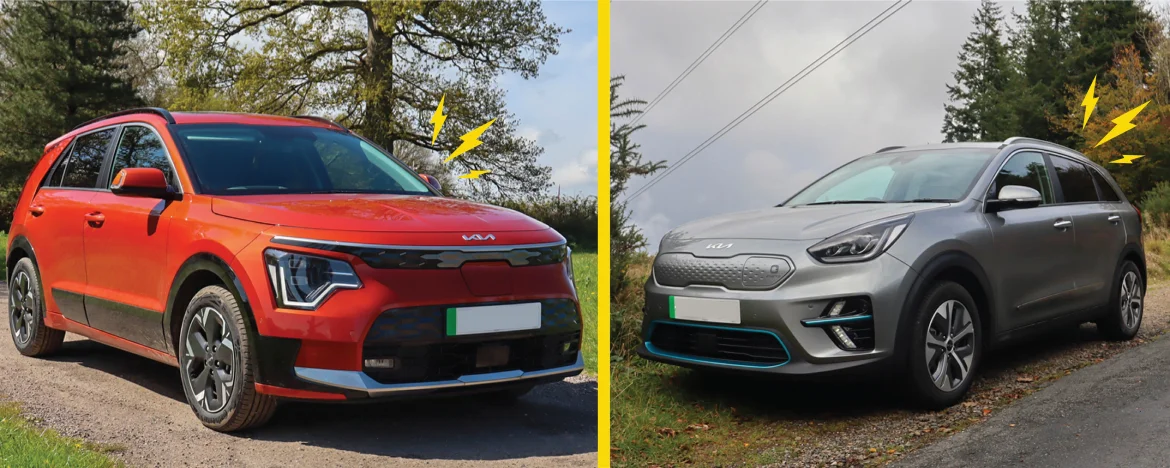
Park it next to the old e-Niro and the older car suddenly looked dated and, well, old. That's despite the e-Niro only getting updated badging in 2021.

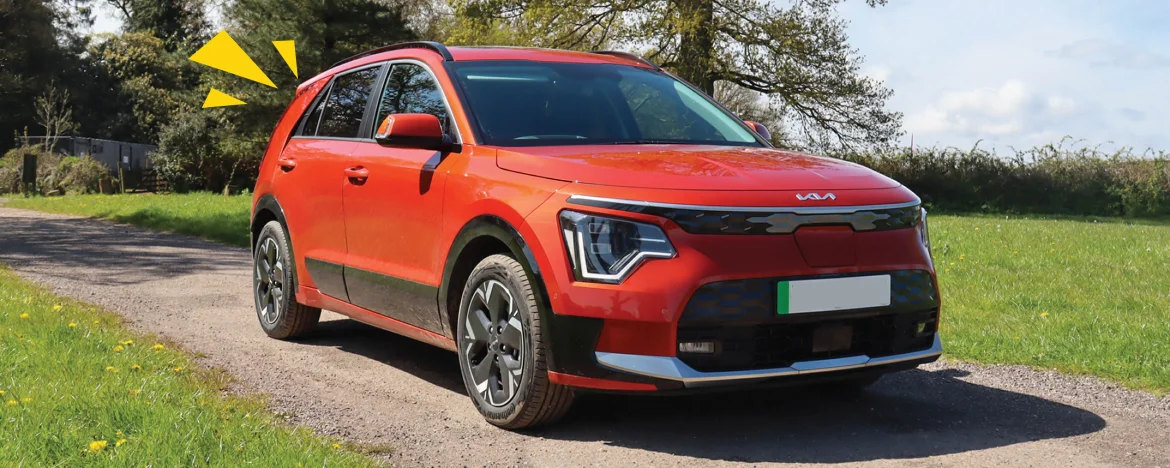
Those big, bulging headlights? Gone. In their place was a boxier, more rounded shape, with boomerang-style LED daytime running lights, a slim grille and a thin chrome strip up front.

The rear was squared off, with matching vertical boomerang-style lights.

Look closer and you'd spot a clever detail. The C-pillar sat away from the bodywork, channelling air along the sides to improve aerodynamics. It could even be specced in a contrasting colour for a bit of extra flair.

We had ours in Orange Flame, paired with black roof rails and contrasting black finishes. It was one stylish family car.

At 4,420mm long and 1,825mm wide, it was roughly the size of a Toyota C-HR or SKODA Karoq. That made it compact enough for town driving and tight school-run car parks.

It had the stance and presence the e-Niro lacked. It looked modern and futuristic without being polarising, which is more than can be said for plenty of EVs.

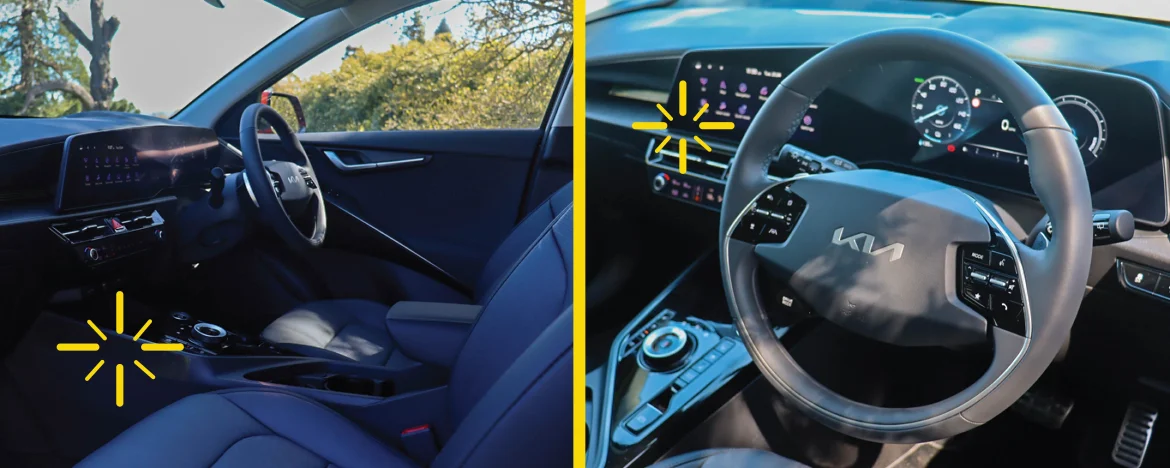
Infotainment screen and driver's display in the Kia Niro EV

A family car through and through

Light, airy, and made for families

Step inside and the Niro EV was light, airy and spacious. It was everything you'd want from a family SUV.

The high driving position gave great visibility, and the sunroof on our top-spec 4 flooded the cabin with natural light.

Quality materials gave it a premium feel without the premium price. What Car? even rated it classier inside than the Volkswagen ID.3.

Head and legroom were generous, even for taller passengers. This wasn't a car a family would outgrow any time soon.

A 10.25-inch touchscreen took centre stage on the dashboard. It was sharp, responsive and easy to use, with clearly labelled menus and handy shortcut buttons. It wasn't as advanced as a Tesla Model Y's, but at this price point, you wouldn't expect it to be.

Connectivity was well covered too. There were USB and USB-C ports up front, plus wireless charging. Rear passengers got two USB-C ports in the sides of the front seats, so there was no squabbling over who got to charge first.

Pop-out cupholders were hidden in the front cubby, which was a nice touch.

Other storage was a bit disappointing though. The door bins would fit a small water bottle and that was about it.

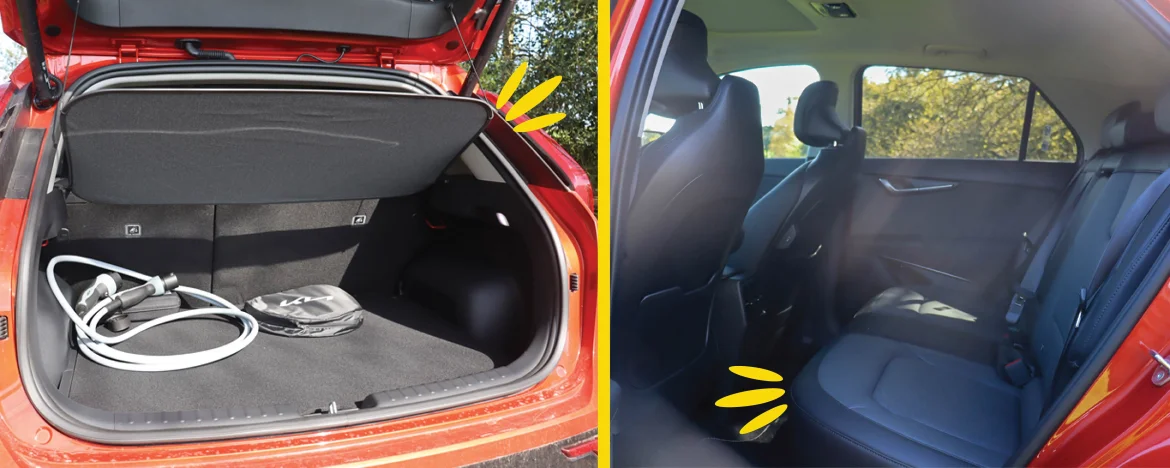
Kia Niro boot space and rear seat space

How many carry-on cases can this boot fit?

The boot offered 475 litres of space. That beat the Renault Megane E-Tech's 440 litres, but trailed the SKODA Enyaq's 585 litres.

To put that into perspective, What Car? Managed to fit seven carry-on cases in the Niro EV, compared to just three in the Smart #1.

There was also a 20-litre frunk under the bonnet, handy for stashing charging cables.

The boxy shape paid off here too, with a generously wide boot opening and only a small load lip to contend with.

Composed, comfortable, and completely drama-free

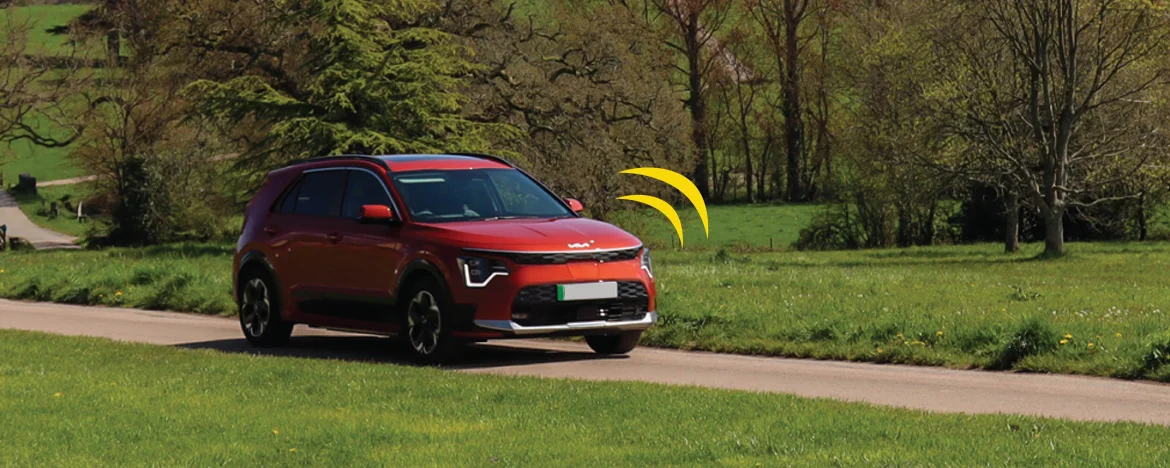
Put your foot down and the Niro EV felt composed and assured. It was a big hit with the Carparison team, which is always a good sign.

It didn't excel in any one area, but it was consistently good in every area. Steering, power and comfort were all solid, and together they added up to a car that was excellent at almost everything it did.

With 204PS on tap, it had all the power you'd need for a car of this size.

Smooth handling and instant torque made it light and easy around town, and it was just as happy to hop onto the motorway.

What Car? also found it more composed and confidence-inspiring on country roads than both the Smart #1 and BYD ATTO 3.

The regenerative braking was customisable, so you could set it as strong or as gentle as you liked. That said, the brakes did feel grabby and heavy, even with regen set to auto.

It could also tow 750kg, enough for a small trailer on weekends away.

What more could you ask for from a family electric SUV?

Kia Niro driving

Efficient and comfortable

The efficiency champ

With a range of up to 285 miles (WLTP Comb), the Niro EV had enough range for most weekly routines.

It wasn't the longest range around, and it was only three miles more than the e-Niro. Rivals like the SKODA Enyaq did go further, with up to 339 miles (WLTP Comb) at a similar price.

But where the Niro EV  really shone was its efficiency.

We averaged 3.8 miles per kWh on our drive, which worked out at around 250 miles of real-world range. Over a longer period, we reckoned 4 miles per kWh was comfortably achievable.

It was the most efficient car in What Car?'s group test too, returning 3.7mi/kWh. That put it ahead of the BYD ATTO 3 at 3.6mi/kWh and the Smart #1 at 3.5mi/kWh.

Charging was a different story. Its maximum DC charging rate was just 72kW, slower even than the e-Niro's 77kW. A 10–80% rapid charge took around 43 minutes, which wasn't the quickest, but wasn't the worst either.

At home, a full charge took around nine to 10 hours on a standard 7kW wallbox, or six to seven hours on an 11kW connection. Plugging in overnight made the most sense.

Safety and warranties

The Niro EV earned a five-star Euro NCAP rating in 2022, with the following scores:

  • Adult occupant: 91%
  • Child occupant: 84%
  • Vulnerable road users: 75%
  • Safety assist: 79%

Kia's seven-year, 100,000-mile warranty came as standard, and it transferred to the next owner within those limits. Many Niro EVs are still covered today, which helps explain their strong resale values.

Servicing was due every 12 months or 10,000 miles, with fixed-price Kia Care plans available to keep costs predictable.

Onboard safety tech included:

  • Forward collision-avoidance assist
  • Smart cruise control with stop and go
  • Lane keep assist
  • Rear parking sensors, with front sensors added from trim 3
  • Remote smart parking assist on trim 4
  • Head-up display on trim 4

What's good, and what wasn’t

The good bits:

  • Excellent efficiency, with 3.8 miles per kWh on our drive
  • Seven-year, 100,000-mile warranty
  • Premium-feeling cabin without the premium price
  • Generous head and legroom, even for taller passengers

The not-so-good bits:

  • Slow 72kW maximum charging rate
  • Tiny door bins
  • Grabby, heavy brakes
Kia Niro next to 2021 Kia e-Niro

2023 vs 2021: Kia Niro

What's the verdict?

The Kia Niro EV was one of the most well-rounded electric SUVs we reviewed.

It didn't excel in one area, but it rarely put a foot wrong. It was practical, efficient and family-friendly, and being solid across the board added up to something excellent.

The technology was reliable, the interior quality matched premium rivals, and it looked the part too.

Slow charging was its biggest weakness. Kia's ground-up EVs, led by the EV3, have since moved the game on with longer range.

But for anyone who wants that Niro practicality without plugging in, the Niro Hybrid carries on.

Five reasons it will be missed:

  1. Proper family practicality in a compact, easy-to-park package
  2. Efficiency that outperformed newer rivals
  3. A cabin that felt far more expensive than it was
  4. Dependable, composed driving on every kind of road
  5. A seven-year warranty that still looks after owners today

So, what should you lease instead?

The Kia EV3, and we'd recommend it without hesitation.

Kia is shifting its electric focus to EVs built from the ground up, and the EV3 picks up where the Niro EV left off.

It offers a much longer range and took What Car?'s Best Small Electric SUV title. It's almost as practical too, despite being smaller.

Prefer to skip the plug altogether? The Niro Hybrid keeps the family-friendly space and seven-year warranty, and it's getting a midlife facelift.

For the right driver, someone who wants a practical, efficient family car with a long warranty behind it, either one is an easy yes.

Does the Kia EV3 sound like your cup of tea?

Ryan Darby

Ryan Darby

Ryan takes the lead on all things 'wordy'. With a sports media background, a true passion for cars, and a LOT of driving experience under his belt, he'll make sure you have all the information you need, when you need it.