Reading Time: 8 minutes | Published 06/10/2020 | Edited: Finley Vile 02/06/2026

Reading Time: 8 minutes
Published 06/10/2020
Edited: Finley Vile 02/06/2026

Is a Tesla Model 3 the right car for you?

TL;DR: Why you should consider leasing the Tesla Model 3

The Tesla Model 3 is one of the most capable electric saloons on the market — offering impressive range, blistering performance, and technology that genuinely improves over time. 

Leasing one makes it more accessible than ever, with fixed monthly payments, no depreciation risk, and the flexibility to move on to something new at the end of your contract. 

If you want to experience the best of what electric motoring has to offer, a Model 3 lease is a compelling place to start. 

Making the case for why you should lease the Tesla Model 3

Tesla changed the game when it came to electric vehicles; taking EVs from expensive, range-limited curiosities to cars people actually wanted to drive.

The Model 3 pioneered that shift. 

A sleek, practical saloon that brought Tesla's cutting-edge technology and over-the-air updates into everyday life. Software on wheels, at a price that made sense.

Bring leasing into the mix and getting behind the wheel becomes even more straightforward. Predictable monthly payments, warranty included, no depreciation risk, and the option to add a maintenance package on top.

So here's our case for why a Tesla Model 3 lease deserves a serious look.
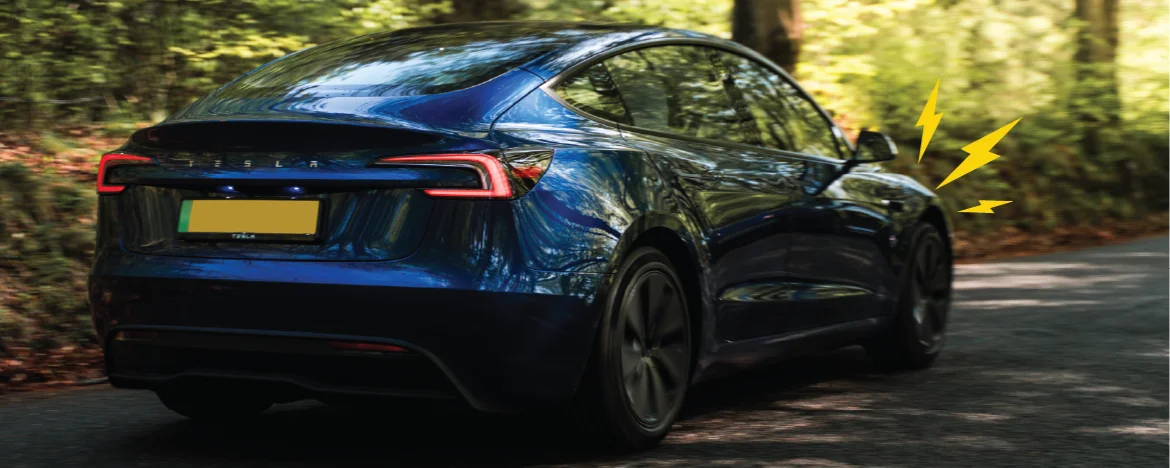
Tesla Model 3

What makes the Tesla Model 3 worth your consideration

Why the Tesla Model 3 makes a great lease

Leasing is a great way to get behind the wheel of some amazing cars, but what makes the Model 3 the choice for you?

We’ve scoured the internet to find your most frequently asked questions to give you the answers you need to make the decision yourself.

Let’s take a look.

Practicality

First up, how practical is the Tesla Model 3?

Can the Tesla Model 3 fit two large suitcases?

Yes — and then some. 

The Tesla Model 3 has 425 litres of boot space. With a typical large suitcase coming in at around 70–120 litres, you could comfortably fit three or four back there.

The saloon shape means vertical space is limited, so taller, bulkier items may need some creative stacking, but for luggage it's more than capable.

Can the Tesla Model 3 fit car seats?

Two car seats fit in the back of the Model 3 with ease, with ISOFIX points and top tether anchor points included as standard. 

Three is possible, though slim-fit seats are advisable if you're going down that route.

Children should not sit in the front passenger seat with the airbag active, as this poses a serious safety risk. 

It's also worth being mindful of the Easy Entry function — the front seats adjust automatically when you exit the car, which could put pressure on a rear-facing seat behind it.

Can the Tesla Model 3 tow?

Yes. The Model 3 has a towing capacity of 750kg unbraked, or 1,000kg with trailer brakes. 

A towing package is available with all the accessories needed to get you hooked up and on the road.

Tesla Model 3 interior

Tech in the Tesla Model 3

Tech

We said the Model 3 is packed with tech, but let’s answer some of your burning questions.

What ambient lighting does the Tesla Model 3 have?

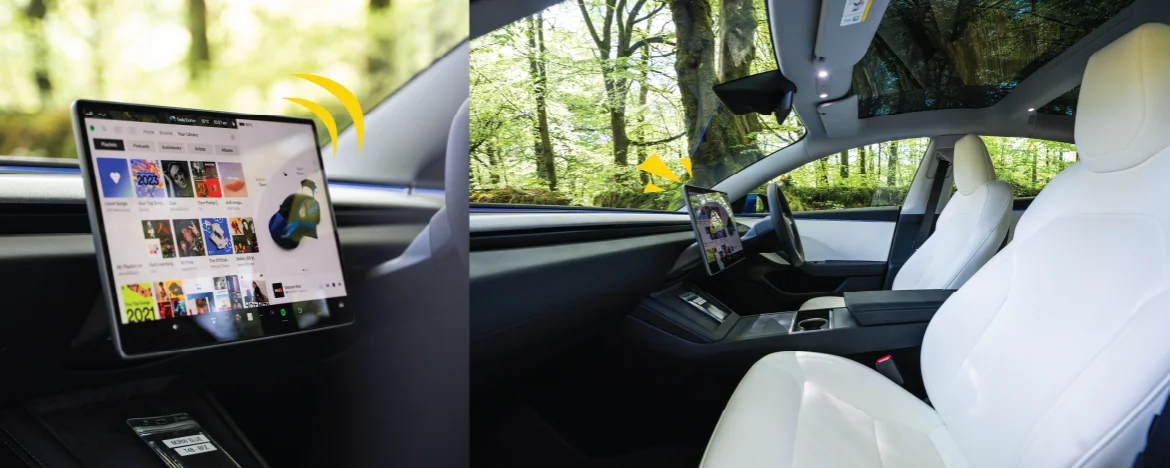
The Tesla Model 3 features customisable RGB ambient lighting that runs along the dashboard and into the door panels, creating an immersive, premium feel inside the cabin.

You can adjust the colour, brightness, and settings directly from the touchscreen.

And your preferences are saved to your driver profile, so the car remembers exactly how you like it.

Ambient lighting isn’t included on the entry-level Rear-Wheel Drive variant, so if this is a must-have, it's worth checking the spec of your chosen trim before you lease.

Can the Tesla Model 3 self drive / park itself?

The Model 3 can park itself using Autopark, which detects parallel and perpendicular parking spaces and manoeuvres into them automatically. A handy feature for tight city spaces.

There's also a Summon function, which lets you move the car in and out of tight spots remotely via the Tesla app — useful when you've parked somewhere awkward and need to squeeze back in.

Both features require active supervision. You need to remain alert and ready to take over at any point.

Tesla's Full Self-Driving (FSD) capability is available in some markets but isn’t currently legal for use in the UK. Autopilot — which handles adaptive cruise control and lane centering — comes as standard on all Model 3s and is available to use here.

Performance

Everything sounds high tech and futuristic, but how does it actually drive? Let's put it to the test:

How fast is the Tesla Model 3?

Quick. Very quick. And that applies across the whole range, not just the flagship.

The entry-level Rear-Wheel Drive model hits 0–62mph in 6.2 seconds and tops out at 110mph. 

Tesla actually dialled back the power slightly on this variant to bring it into a lower insurance group. A practical win for everyday drivers.

And it's still faster than most hot hatches.

The Long Range AWD cuts that sprint to 4.2 seconds, while the Performance model is in another league entirely — 0–62mph in 2.9 seconds and a top speed of 163mph. 

For context, that's quicker than a Porsche 911 Carrera.

What makes the acceleration feel even more dramatic is the instant torque delivery. There's no lag, no build-up, just immediate, linear power the moment you press the accelerator. It never gets old.

The Performance model also gets a Track Mode, letting you adjust power distribution between the axles and dial in the stability control to suit your driving style. It's the one to go for if the drive matters as much as the commute.

Tesla Model 3

Is the Tesla Model 3 worth the money?

Money

Alright, it sounds like an amazing car. But how much does it cost? And then how much does it cost to actually drive it?

How much does the Tesla Model 3 cost?

The Tesla Model 3 starts at £37,990 for the Rear-Wheel Drive, with the range topping out at £59,990 for the Performance. There's genuine breadth in that lineup, with the Long Range variants sitting in between and offering a strong middle ground for most drivers.

How much does the Tesla Model 3 performance cost?

The Performance model is priced at £59,990 OTR. It’s the flagship of the range, and arguably the one that makes the most sense if performance is your priority.

Is the Tesla Model 3 expensive to insure?

More than a comparable petrol car, yes. It's a premium, tech-heavy vehicle with a higher purchase price, and insurance groups reflect that. 

The Rear-Wheel Drive sits in group 36, partly because Tesla deliberately reduced its power output to bring it into a lower group.

The Long Range models sit higher, and the Performance reaches group 48, which is typical for a car hitting 0–62mph in under three seconds.

Reliability 

But now the all important reliability test. 

Yes, it's a great car, but will it be in the garage more than on your driveway?

Are Tesla Model 3 good cars?

In short, yes. 

The Tesla Model 3 has earned its reputation as one of the best electric saloons on the market, and the reviews back it up. Autocar rated it 8/10, Auto Express praised its efficiency, and it holds a five-star Euro NCAP safety rating.

The interior quality has improved significantly with the Highland facelift. Early Model 3s had a reputation for panel gaps and rattles, but the current car feels genuinely premium.

How reliable is the Tesla Model 3?

The Model 3 is mechanically straightforward by EV standards — fewer moving parts than a petrol car means less to go wrong. 

Over-the-air updates handle software fixes automatically, so you're not waiting for a service appointment to resolve issues.

The leasing context helps here too. 

Within a standard lease term you're covered by the manufacturer's warranty throughout, and you're handing the car back before the longer-term ownership concerns become relevant.

Does the Model 3 come with warranty?

The Tesla Model 3 comes with a four-year or 60,000-mile bumper-to-bumper warranty covering manufacturing defects under normal use. 

The battery and drive unit are covered separately for 8 years or 100,000 miles, with a guaranteed minimum of 70% battery capacity retention throughout.

For most lease drivers, this means you're fully covered for the entire contract — and the battery warranty extends well beyond it.

Tesla Model 3

Any negatives with the Model 3?

Does it have any downfalls?

Nothing can be perfect, so let’s look at its downfalls so you can make your own informed decision:

  • Ride quality: The suspension is firm, particularly on the entry-level RWD which has fully passive dampers. On rougher UK roads it can feel unsettled
  • Touchscreen dependency: Almost everything runs through the 15.4-inch screen, including wipers and indicators (though the stalk came back in 2025). Takes getting used to and frustrates some drivers
  • No Apple CarPlay or Android Auto: Still absent, which is a genuine gripe at this price point
  • Rear space: Adequate but not class-leading. Taller passengers in the back will notice it on longer journeys
  • Saloon boot opening: 425 litres is a decent amount of space but the saloon-style opening makes loading bulky items trickier than a hatchback
  • Motorway wind noise: Improved with the Highland facelift but still present through the front pillars at higher speeds
  • Insurance: Higher groups than comparable petrol cars, which affects monthly running costs

Why leasing a Tesla Model 3 makes sense

We’ve explained why the Model 3 is a great car, but why lease? A few reasons really:

  • No depreciation risks: No need to worry about depreciation or selling it after you use. Simply hand back at the end of your lease
  • Warranty: You're covered by Tesla's 4-year/60,000-mile vehicle warranty and 8-year/100,000-mile battery warranty for the full term of a standard lease — peace of mind built in
  • Fixed monthly costs: No surprise bills, making it easier to budget
  • Flexibility: At the end of your lease, you simply hand it back and lease another brand new car
  • Optional maintenance package: Can be added so you truly have no surprise bills. Servicing, tyres and more are covered

What are the downsides of leasing?

Leasing isn't for everyone. Here's what to consider before you commit:

  • You won't own the car at the end of the contract
  • Mileage limits apply, and exceeding them will result in excess mileage charges
  • You're committed for the duration of the contract, so early termination can be costly
  • The car must be returned in good condition — fair wear and tear is expected, but damage beyond that will be charged
  • You won't benefit if the car increases in value
Tesla Model 3

Should you lease the Tesla Model 3?

Should you lease the Tesla Model 3?

If you want the latest EV tech with the lowest possible commitment — yes. The Model 3 suits a wide range of drivers, and leasing makes it more accessible than ever.

You should lease if:

  • You want a premium electric car without the premium outlay
  • You commute regularly and want to slash your fuel costs
  • You want the security of a warranty and fixed monthly payments
  • You have access to home charging, or easy access to Tesla's Supercharger network
  • You like the idea of moving onto the next model at the end of your contract rather than being tied to a depreciating asset
  • You're an EV-curious driver who wants to try electric without the long-term ownership risk

Have we sold you on the Tesla Model 3?